coordinator(s)
Contact(s)
thanks
In France
- Institut Carnot ICEEL
- Pôle Scientifique EMPP de l’Université de Lorraine
- Laboratoire Réactions et Génie des Procédés de l’Université de Lorraine
- Laboratoire Génie Industriel, LGI – CentraleSupelec
World:
- Free Appropriate Sustainability Technology (FAST) Research Group – Western University – Canada
- Universidad de Santiago de Chile – USACH
Green Fablab (2013 - )
Context
The Green Fablab concept is an action-research initiative of the École Nationale Supérieure en Génie des Systèmes -ENSGSI- et de l’Équipe de Recherche sur les Processus Innovatifs -ERPI- at the Université de Lorraine.
As a research focus, the goal is to better understand the challenges of the circular economy in order to transform local resources—particularly plastic waste—and to highlight more sustainable and responsible production alternatives, in line with the goals of the ecological transition.
As a field of action, in recent years, open fabrication spaces such as Fablabs and third places in France have emerged as socio-technical alternatives to traditional industry, fostering urban manufacturing approaches at the social and solidarity economy with positive environmental and social impacts. In this sense, the partnership between the university and open-manufacturing explores the opportunity to operate at the intersection of research, education, and citizen-driven innovation for a local community.
For universities, this enables the training of new generations in green skills and the identification of new organizational models and roles (in engineering, for example) necessary to support our society.
For third places, this offers a learning space open to the public and contributes to their visibility through the development of a unique experimental space.
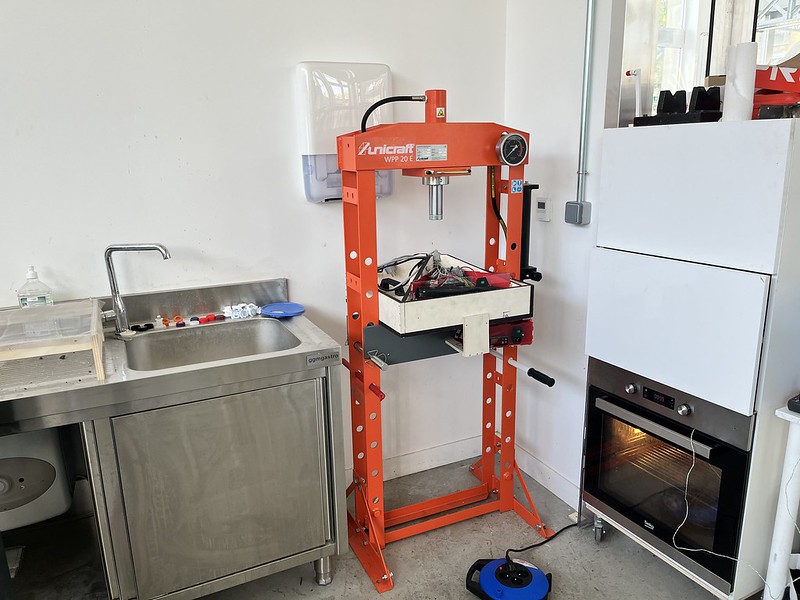
Today, establishing a local recycling network is one of the key strategies for formalizing a distributed approach to the reuse of plastic materials. Incorporating these recycled materials into co-creation spaces allows us to view this waste as a resource and transform it into “new raw materials.”